
Quick Actions
Contents
Central Nervous System
Central Nervous System Physiology explores how the brain and spinal cord regulate body functions, process sensory information, coordinate motor responses, and support higher mental activities. This topic explains the functional organization of major CNS regions, neural pathways, protective mechanisms, and integrative processes such as consciousness, memory, and reflex control. Students will learn the physiological principles that enable the CNS to maintain homeostasis and support coordinated organ and system function.
Learning Objectives
- Describe the major structural and functional divisions of the central nervous system.
- Explain how the spinal cord processes sensory input and coordinates motor output.
- Discuss the roles of brain regions including the cerebrum, cerebellum, and brainstem.
- Explain cerebrospinal fluid formation, circulation, and importance.
- Describe the blood brain barrier and its protective functions.
Key Points to Remember
- The CNS consists of the brain and spinal cord.
- The brainstem maintains cardiovascular and respiratory regulation.
- The cerebellum coordinates balance and fine motor activity.
- Cerebrospinal fluid protects, nourishes, and cushions the CNS.
- The blood brain barrier regulates passage of substances into neural tissue.
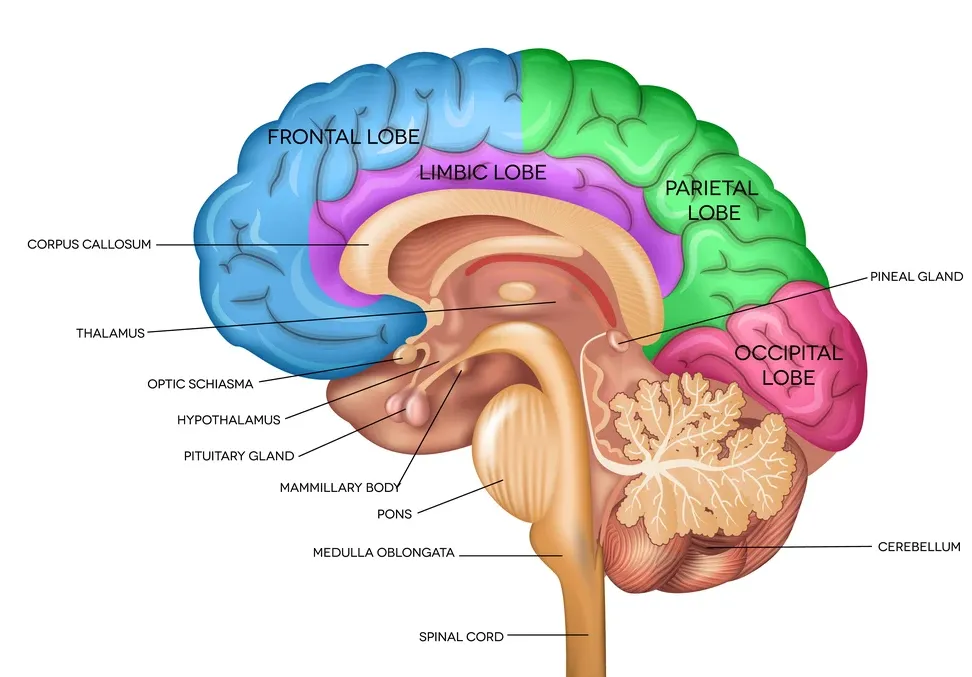
The central nervous system is the primary control center for the human body. It processes sensory information from internal and external environments, integrates this information, and produces coordinated responses.
It is composed of the brain and spinal cord, both enclosed within protective structures and supported by complex physiological processes that ensure stable function.
Structural Organization of the CNS
1. The Brain
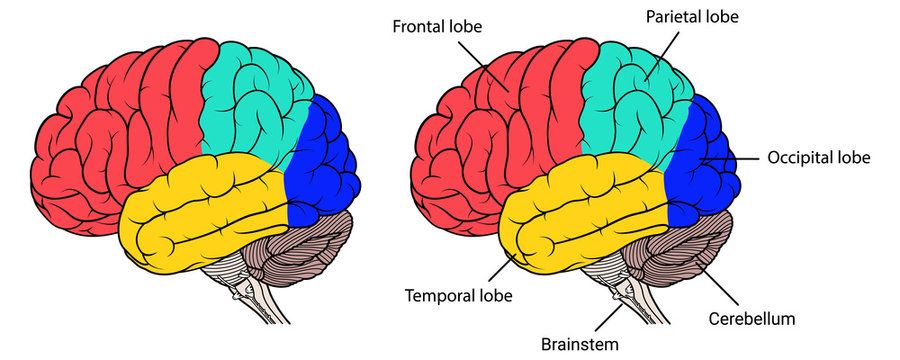
The brain is divided into major regions with distinct functions.
Cerebrum
The cerebrum is the largest part and is responsible for conscious thought, voluntary movement, perception, learning, and memory. It is divided into two hemispheres connected by the corpus callosum, enabling interhemispheric communication. The surface is covered by the cerebral cortex made of gray matter, while underlying areas contain white matter tracts.
The cortex has functional areas:
Diencephalon
Located beneath the cerebrum, it consists of:
The hypothalamus is often remembered with the mnemonic “T H E A M P” referring to Temperature, Hunger, Endocrine control, Autonomic function, Motivation, and Preservation behaviors.
Brainstem
The brainstem includes midbrain, pons, and medulla. It maintains vital functions such as respiration, heart rate, and blood pressure. It also contains reflex centers for coughing, swallowing, and vomiting.
Cerebellum
The cerebellum coordinates muscle tone, posture, balance, and precision of movement. It compares intended movement with actual performance and makes corrections. Damage results in ataxia and intention tremor.
The Spinal Cord
Structure
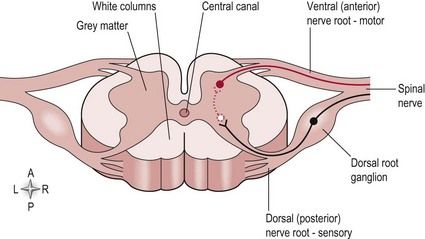
The spinal cord extends from the medulla to the level of L1–L2 vertebrae. It is organized into segments from which spinal nerves emerge. The central gray matter contains neuronal cell bodies arranged in horns, while the surrounding white matter contains ascending and descending tracts.
Functions
Ascending Pathways
Common sensory tracts include:
Descending Pathways
Major motor tracts include:
Reflex Physiology
Reflexes are rapid, involuntary responses to stimuli. They protect the body and help maintain posture.
Components of a Reflex Arc
- Receptor
- Sensory neuron
- Integration center
- Motor neuron
- Effector
Spinal reflexes such as the stretch reflex do not require brain involvement, although the brain may modulate them.
A mnemonic for reflex arc steps is “R S I M E” meaning Receptor, Sensory neuron, Integration, Motor neuron, Effector.
Cerebrospinal Fluid Physiology
Formation
Cerebrospinal fluid (CSF) is produced by the choroid plexus in the ventricles. It is formed by selective filtration of plasma and active transport processes.
Circulation
CSF flows from the lateral ventricles to the third and fourth ventricles, then enters the subarachnoid space around the brain and spinal cord.
Functions
Disorders of CSF circulation can lead to hydrocephalus and increased intracranial pressure.
Blood Brain Barrier (BBB)
The blood brain barrier is formed by endothelial cells with tight junctions, basement membrane, and astrocyte foot processes. It restricts passage of large molecules, toxins, and pathogens while allowing essential nutrients like glucose and amino acids.
Importance
Drugs such as L-dopa for Parkinson disease are designed to cross the BBB, while many antibiotics cannot.
CNS Integration and Higher Functions
Sensory Integration
The CNS receives sensory information from peripheral receptors. The thalamus filters and relays this information to the appropriate cortical areas for interpretation.
Motor Control
Motor commands originate from the primary motor cortex. They are modified by the basal ganglia and cerebellum to ensure smooth, coordinated movement.
Autonomic Regulation
Hypothalamic centers regulate internal organ function, maintaining homeostasis by balancing sympathetic and parasympathetic activity.
Consciousness and Sleep
Consciousness depends on the reticular activating system located in the brainstem. Sleep cycles are controlled by interactions between the hypothalamus, thalamus, and brainstem.
Learning and Memory
The hippocampus is essential for forming new memories, while the cortex stores long term information. Synaptic plasticity, especially long term potentiation, strengthens synapses with repeated use.
Protective Mechanisms of the CNS
Meninges
Three protective layers surround the CNS:
Skull and Vertebral Column
These bony structures provide rigid protection against external injury.
Neuroglia
Cells such as astrocytes, microglia, oligodendrocytes, and ependymal cells support neural function, remove debris, and maintain physiological stability.
Test Your Knowledge
Complete the quiz to check your understanding.
Ready to take the quiz?
Please log in to save your progress and see how you stack up!
Log In to ContinueAdditional Resources
See More Resourses
Watch more on Youtube